 |
 |
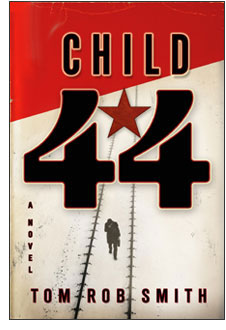 Tom Rob Smith
Child 44
Reviewed by: Terry D'Auray © 2009
Grand Central Publishing, Hachette Book Group
US Hardcover First
ISBN: 0-446-40238-9
436 Pages; $24.99
Publication Date: April, 2008
Date Reviewed: April, 2009
Index:
Mystery
General-Fiction
Tom Rob Smith's debut novel offers a distinctive twist on the all-too-standard serial killer genre. But you won't even know that you're reading a serial killer novel until you're well into the 400-plus-page book. 'Child 44' is, in fact, a two-fer — a chilling, gripping narrative of lives lived in fear and paranoia in Stalinist Russia in the 50's that morphs into a unique killer-on-the-loose thriller.
Taking as his premise the true story of serial killer Andrei Chikatilo, a child-killer in Russia from 1978 through 1990, Smith moves the story to Russia in the early 1950's, where the Stalinist doctrine decrees that, unlike the greedy and corrupt Western world, all is well within the Russian one. Since all needs are met by the State there's no motivation for its citizens to commit such unsavory crimes as robbery, bribery, and, of course, murder. Leo Demidov, former war hero and current MGB officer, diligently defending the State from traitorous acts by its own citizens (the only crimes that are acknowledged are those against the State), comes across unmistakable evidence of a serial killer murdering children across the country. But there is no crime in Stalinist Russia and to suggest otherwise is itself a crime against the State. To catch the killer, Demidov must become a criminal himself, risking his position, his family's well-being, exile or, most likely, death.
Leo's position as an MGB officer grants him, his wife Raisa and his family luxuries not available to most Russians. But the price is steep — constant vigilance and highly visible loyalty to the party and a willingness to torture and often condemn to death citizens accused of crimes against the State. Leo survives by suspending his conscience and keeping his head down and his guard up.
Smith deftly details this world driven by suspicion and fear, where paranoia is prudent and the slightest misstep, an errant glance, a misinterpreted facial expression can fuel suspicion and spark an investigation from which there is no good outcome, and no appeal. Smith's language is deceptively simple but densely atmospheric as he slowly ratchets up the tension, event-by-event, confrontation by confrontation. Stalinist Russia in the 50s is not a place you'd want to inhabit for long.
But much changes as the narrative progresses and not necessarily for the better. The dread and suspense of the early chapters gives way to action and adventure as Leo is demoted and he and Raisa, exiled to a remote part of the country, begin to piece together evidence that points to a serial killer preying on children across the Russian state. A moral transformation accompanies Leo's social decline as he and Raisa partner to bring the killer to justice. While the action sequences are energetic and tense and the primary characters are compelling, the dramatic personal changes and daring actions push the credibility meter into dangerous territory. Smith's final surprise twist is disappointing and wholly unnecessary, a letdown where there should have been satisfaction. While well worth reading for the insightful window into Stalinist Russia, there is inside this 400-plus page novel a truly exceptional and unique 300-page story just waiting to get out.
|
|
|
|
|
Review Archive
All Reviews alphabetized by author.
General Fiction
Non-Genre, general fiction and literature.
Horror
Supernatural fiction, supernatural horror and non-supernatural horror.
Science Fiction
Science fiction, science fantasy, speculative fiction, alternate history.
Fantasy
Fantasy, surrealism and magic realism.
Mystery
Crime, thrillers, mystery, suspense.
Non-Fiction
Non-Fiction, True Crime, Forteana, Reference.
Poetry
|
|
|

















