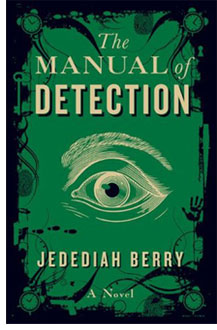
The Penguin Press / Penguin Putnam
US Hardcover First Edition
ISBN 978-1-59420-211-7
Publication Date: 02-23-2009
280 Pages; $25.95
Date Reviewed: 06-13-2009
'The Manual of Detection' is not what it pretends to be. It is neither non-fiction, nor is it a manual. Indeed, the title refers to a fictional work of non-fiction referred to and often quoted in the novel, which both pretends to be and is — and is not — a classically-styled piece of hard-boiled noir. Nothing, it seems, is what it seems to be. The world we live in may be a novel, the works of non-fiction that hold our lives may be a farrago of lies, and our dreams may be more dangerous than the drudgery of our everyday lives. Jedediah Berry is more than a clever craftsman; he's a master criminal out to steal your dreams, or even more ominously — to bring them to life, your life.
For all the metaphysical ingenuity that underpins 'The Manual of Detection,' the novel and the telling are quite straightforward; at least to begin with. Charles Unwin works in a city where it always rains, for The Agency. He's clerk, a nothing, a non-entity even in his own formulations, and quite happy in that role, though he does have his eccentricities. Lately, he's been taking the long way to work, to watch a woman in plaid board a train. Today, however, is not his lucky day. The detective for whom he correlates notes and closes cases has gone missing. Unwin has been promoted, and his first case is to find his detective, Travis Sivart, the man who solved so many famous cases; "The Three Deaths of Colonel Baker" and "The Man Who Stole November 12th." And all this without even being given the limited edition of 'The Manual of Detection.'
Berry's prose is rain-slicked and grimy, detailed and compelling. Once you start the novel, you'll feel the presence of the city, even though it will never be named. Berry's flowing style surrounds and enfolds the reader, suckering you into a world almost like the one you inhabit. In some ways, it's more real, in some ways, it's less real, and in every way it is surreal. There's a real cinematic feel at work at well. After reading this novel, you'll be able to look up the rain-slicked sides of the Agency's skyscraper, you'll be able to wander through the rubbish-strewn aisles of the Travels-No-More Carnival, and you'll stroll through the Museum in the after-hours hush.
While 'The Manual of Detection' starts out seeming as if it is a sort of surrealized-amalgam of every noir ever written, Berry's plot quickly goes places you will not expect. What start out as hints of unease and impenetrable shadows are soon filled in by a cleverly constructed plot that takes Unwin at least two steps beyond any reality the reader might hope to reside in. From the get-go, it's clear we're in no-City and every-City, the mythic sum of all the mean streets that were ever mapped in the written and film noir worlds. And Berry admirably works within that genre, until he manages to slip right and into the metaphysical dream worlds that inform our so-called "realistic, hard-boiled" detective fiction. This sort of writing has always been a dark dream of the City; Berry takes that idea literally, and conjures up a literary work to suit the facts of the dreams and the dreams of the facts.
None of this would work if it weren't for Berry's characters, who really stick in readers' minds. Unwin is not really a likeable guy, but he's a compelling character. He really doesn't want to be a detective, even though as a reader you love him as a detective. His sidekick, so to speak, Emily Doppel, is first met asleep at her desk, but she quickly becomes so loveable that you'll be hard-pressed not to think of which actress you'd want to play her in the movie. Travis Sivart is the man who isn't there, and yet, you'll want him on your side. Enoch Hoffman tends more towards the Saturday matinee side of things. He's the bad guy, but at least he never cackles.
There's no denying that 'The Manual of Detection' is more unusual than you might expect or even (at first) want it to be. Berry's mythic invention of a noir made real leads one to understand just how unreal such constructs were. Readers expecting purity of any form will be disappointed. This is not a simple noir, nor is it a weird work replete with the fantastic. Instead, the hard-boiled and the very weird work together to take readers to a new place altogether. You turn the pages and start to dream of the City. Whether or not you ever wake up from that dream is a mystery that is more easily stated than solved.
New to the Agony Column
08-08-11: Commentary : Simon Rich Wishes For 'Elliot Allagash' : The Unbottled Genie
Agony Column Podcast News Report : A 2011 Interview with Simon Rich : "My goal as a writer, more than anything is just to write something that people will finish voluntarily."
08-03-11: Commentary : Scott Simon Knows 'Baby, We Were Meant for Each Other' : The Family We Choose
Agony Column Podcast News Report : A 2011 Interview with Scott Simon : "...then of course, our kids will be there too, and that's going to change everything."
08-01-11: Commentary : Glen Duncan Transforms 'The Last Werewolf' : The Literature of Ennui
Agony Column Podcast News Report : A 2011 Interview With Glen Duncan and Stephen Coates : "I try and imagine what it would be like to be that person in that situation."
07-28-11: Commentary : Bruce Duffy Proclaims 'Disaster was My God' : Seasoned in Hell
Agony Column Podcast News Report : Five Books With Alan Cheuse : The Lotus Singers edited by Trevor Carolan, Digital Geishas and Talking Frogs, Edited by Helen Mitsios, Disaster Was My God, by Bruce Duffy, Triple Crossing by Sebastian Rotella and We All Fall Down by Michael Harvey
07-27-11: Commentary : Arielle Eckstutt and David Henry Sterry write 'The Essential Guide to Getting Your Book Published: How to Write It, Sell It, and Market It . . . Successfully' : Swiss Army Knife for Would-Be Writers
07-25-11: Commentary : Mark Seal Meets 'The Man in the Rockefeller Suit' : Unmistaken Identity
Agony Column Podcast News Report : A 2011 Interview with Mark Seal : "He said he was the producer and director of a new TV series called Alfred Hitchcock Presents."
07-21-11: Commentary : 'Song of Slaves in the Desert' by Alan Cheuse : Voices, Stories and Songs
Agony Column Podcast News Report : Alan Cheuse Live at Capitola Book Café, July 9, 2011 : "..if any of you have ever spent any time in academia, you can imagine what this meant..."
07-18-11: Commentary : David Eagleman Goes 'Incognito' : Dethronement
07-15-11: Commentary : David Darlington Searches for 'An Ideal Wine' : One Generation's Pursuit of Perfection — and Profit — in California
Agony Column Podcast News Report : A 2011 Phone Interview with David Darlington : "...the fact that so many wineries mouth this catechism while behind the scenes they are doing something completely different..."
07-13-11: Commentary : Joe R. Lansdale's 'Crucified Dreams' : Urbane Extreme
Agony Column Podcast News Report : Howard V. Hendrix Interviewed at SF in SF on May 9, 2011 : "We're going to bring in people from all different menus who have talked about Mars."
07-04-11: Commentary : Donald Ray Pollock Sees 'The Devil All the Time' : Flaying Americana
Agony Column Podcast News Report : A 2011 Interview with Donald Ray Pollock :"You need some trouble, you know, for the book to be interesting. I may go a little overboard on the trouble."
06-30-11: Commentary : Melissa Marr Minds the 'Graveminder' : Tending to the Dead