There's something about a set of books that is appealing beyond reason — I suppose. I know from the get-go, when I'd ride my avocado-green Stingray bike to the book store in Covina, I was attracted to series and sets of books. I bought all the Jules Verne and H. G. Wells paperbacks. The Edgar Rice Burroughs "John Carter of Mars" series, with those famous Frazetta covers were packed together on my little bookshelf. And I took the bus from Covina to Los Angeles to, I believe, Vagabond Books, to buy the entire paperback sets of the Arthur Conan Doyle's Sherlock Holmes and Professor Challenger books. Lined up on shelf, there's something magical about a good series.
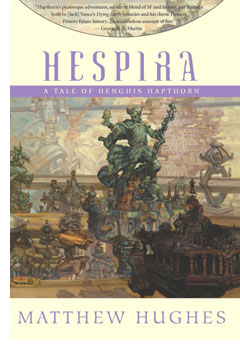
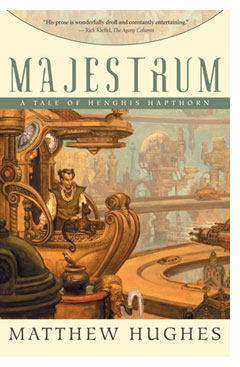
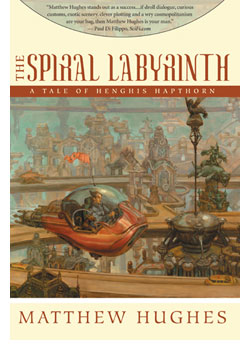
All this reminiscing is the result of the arrival of 'Hespira' (Night Shade Books ; December 15, 2009 ; $24.95), the third in Matthew Hughes' sublimely wonderful Henghis Hapthorn series. Like the first two books in the series, 'Majestrum' and 'The Spiral Labyrinth,' 'Hespira' features cover art by Tom Canty combined with a fine jacket design by Claudia Noble.
My immediate urge upon receiving them was to line them up and look at them, because, it's just so cool to have such a nice series. This is the sort of thing that makes this half-a-millennium technology so appealing. Take that, iPad. You can hold these suckers in your hand, unlike a bunch o' damn pixels.
But to a certain degree, the work of Matthew Hughes exists beyond the page and beyond the pixels and it really doesn't make a tinker's damn of difference how the words get into your brain. (Oh yes it does! They must come from books lined up on your shelves with attractive covers!) Hughes writes these light, witty entertaining japes about a detective set in a far-flung future where not only is technology indistinguishable from magic, it's devolving right before the jaded eyes of said detective ("freelance discriminator") Henghis Haptorn and being replaced by magic.
But his prose is utterly amazing, his plots move with the precision of jeweled watch and you can't help but love his entertaining characters. Hughes sort of says, "Aw shucks," with every word, but he's writing at a level well beyond the apparently low gravity of these books.
And I say "apparently low gravity" because even though our main character is a freelance discriminator, who in this adventure recovers some stolen property with unfortunate consequences — one of which may be the introduction of the titular Hespira, a rather attractive woman of mystery, into his life —this con-game comedy set in a meticulously imagined universe tosses off smart, pithy perceptions as often as clever jokes.
Hughes has a lot to say about the way we relate to one another and whatever world we may find ourselves in, but he does so with an off-hand panache that is disarming.
Plus, he writes great actions scenes, manages to create some nasty monsters now and again, and generally does everything necessary to make sure the reader has a hell of a good time.
For their part, Night Shade offers the good time feeling of an old-fashioned science-fantasy series. Well-produced, superbly written, you can't go wrong here.
Order up all three, straight from the publisher, but pace yourself when you read them. They're easily re-readable for the witty prose — but you can only read them for the first time once.
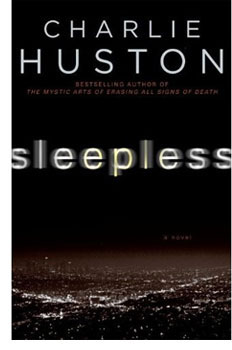
01-28-10: A Review of 'Sleepless' by Charlie Huston
A Father Fears the Future
'Sleepless' is a departure for Charlie Huston, in a variety of ways. It's also a book that can be easily ruined by over-enthusiastic reviews, or even comments that to my mind, can reveal too much of the plot. Even the dust jacket tells too much here. The best way to approach 'Sleepless' is to remain consciously clueless.
I've shaped my review of 'Sleepless' to make sure that I don't give away anymore than I knew going in, which wasn't much. I knew the book was science fiction going in, and I have to admit that I was a bit worried about this, for no reason. Huston has a natural feel for science fiction. His world-building is faultless. He creates a day-after-tomorrow vision of Los Angeles that is rooted in real geography and landscapes but overwhelmed by a violent, disenfranchised populace seething with anger and resentment. They're also armed to the hilt, so expect a variety of excellently orchestrated scenes of confrontation, violence and mass mayhem.
However, the core of then novel is the purely emotional terror of a new father who has brought a beautiful child into a world that seems likely to kill her. Huston hits raw nerves with rough prose, presenting his characters with unhappy choices. The pacing is fast, but not frenetic, though the characters find themselves immersed in an overwhelming tide of chaos. You'll find a variety of clever spins on virtual reality, futuristic diseases and crime, which accelerate the plot and enhance the emotional impact. There's a bit of beauty at the core of this novel. 'Sleepless' is a gripping, intense and ultimately powerful novel about the very near future. It's probably too late to change course now.
01-27-10:Glen Cook Walks the 'Shadowline'
Every Old (Science Fiction) Thing is New (Space Opera) Again
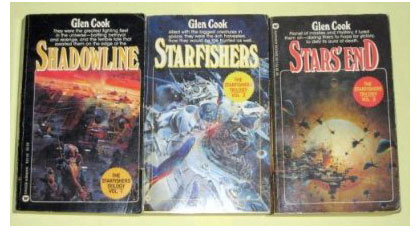
OK, so maybe we were a little hasty with the whole "New Space Opera" thing. It's not like that is such a surprise. Even as "New Space Opera" was getting it's own tome-like volume of stories, eyes were turning back to glance at the work of say, Iain M. Banks, whose Culture universe is clearly a bit bigger than an influence. And now, thanks to Night Shade Books, we can turn back again, to Glen Cook.
I suppose it shouldn't surprise us that Cook's 1982 space opera, new or not, came out first as a series a cheerfully cheesy paperbacks. Space opera's closest cousin was at that time the also-cheerfully-cheesy Star Wars trilogy-in-progress; the first movie did its cultural shake-and-bake six years before, and the follow-up, The Empire Strikes Back, viewed by most as an improvement on the original, was still fresh in our memories. Dancing teddy bears were still in our future, thankfully. It was in this environment that Cook's first foray into science fiction fell. The 80's horror boom was getting started and far-flung space empires didn't seem quite so relevant, even though America was engaging what its leaders called an "evil empire."
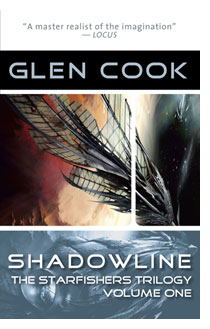
Now Cook's prescient science fiction trilogy is coming back, starting with 'Shadowline: The Starfishers Trilogy Volume One' (Night Shade Books ; January 15, 2010 ; $14.95). You've got all the great components here of what has become familiar in the twenty-eight years that followed. Ancient space empires, centuries old family vendettas, inscrutable aliens, and well-orchestrated battles – deployed with the same verve that Cook brought to his fantasy. What Cook does so well is to orchestrate the inequalities and the emotions of his protagonists, to grey-over any presumptions we might make about what is good and what is and to show that violence is more neutral than any human can claim to be. We see crime in the future as well as war. Cook offers more than a series of battles. He offers a society, human civilization spread out across the stars. And he offers a satisfyingly complicated plot, carried out by characters we like even when they're doing things that are very unlikeable.
We like to think that every moment we are born anew, and our world is born anew with us. But the printing press, and the books it brings us, are more than five hundred years old. It's not impossible that some monk dreamed of the heavens, and populated them with clashing warriors. How old is the New space opera? Does it matter? The books endure. Humans endure. Space opera ... endures...
A good work of art makes you care about people. How that comes to pass is up to the creator. You can write hundreds of pages about one man's recollections looking in a teacup. You can write a taut, stripped-down stage play with twelve men locked in a room, acting as a jury deliberating on a crime. You can have pilgrims stuck in mid-journey, whether it is a group travelling from Southwark to the shrine of Saint Thomas Becket at Canterbury Cathedral in the 14th century, ('The Canterbury Tales' by Geoffrey Chaucer) or a group of space travelers sent on a pilgrimage to the Time Tombs on Hyperion. ('The Hyperion Cantos' by Dan Simmons). When a character tells a story about him or her self, we know from the get-go that we're dealing with an unreliable narrator. Nobody tells the truth well.
Chitra Bannerjee Divakaruni knows something about being a pilgrim. Born in Calcutta, she received her BA from the University of Calcutta, but came to the United States to get her Master's. Not surprisingly, Divakaruni's own story is something of a classic; to pay for Grad school, she worked through a very American variety of jobs, from the menial work of a babysitter to the more austere employment teaching at American colleges. When she writes about people being adrift away from home, it's a personal story no matter what sort of character she has created.
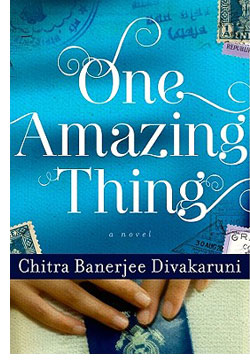
Divakaruni's latest novel is 'One Amazing Thing,' (Voice / Hyperion ; February 2, 2010 ; $23.99), and in it she puts her own spin on the trapped storytellers trope. We meet nine characters in an Indian consulate in an unnamed American city, knowing that Divakaruni has spent a good deal of time in Berkeley, California. This is relevant because the nine are quickly trapped by an earthquake, a feeling not unfamiliar to anyone who has spent time in Berkeley. You might not have been trapped, however, it's always just a temblor away.
Once they're stuck, Divakaruni's characters decide to pass the time telling stories, telling about, as one character requests, "one amazing thing" that has happened to them in their journeys. Since we're talking about characters in an Indian consulate on American soil, we're pretty much automatically talking about pilgrims, even if they're Americans; pilgrimage is a universal human condition. And Divakaruni taps into that universality with incredible sentences and carefully crafted tales.
Of equal importance, at least to this reader, is the fact that Divakaruni, a gifted short story writer, used the form of the novel well, but sparsely, telling her story in a direct and brief manner. Nine lives spin out in just over 200 pages, but we feel the richness of each character's life. With all this vasriety and all this brevity, the book reads like lightning, even though Divakaruni chooses to focus on the characters as opposed to the tension built into their perilous situation. If you're looking for a thriller, this is not that. If you think humans are thrilling, then this is your book.
01-25-10:Elizabeth Bear and 'Bone and Jewel Creatures'
From Obscurity to Ubiquity
It's funny how you feel when something you feel discover becomes wildly popular. There's a wistfulness really, and a certain level of disappointment. Any relationship is better when it feels smaller, more unique. Reviewers experience this regularly; writers not so often. But I can really understand how Elizabeth Bear feels about steampunk, when she writes in her blog: "So the thing about the steampunk aesthetic that everybody's talking about: it's weird to me, like watching a band you've loved for years get popular."
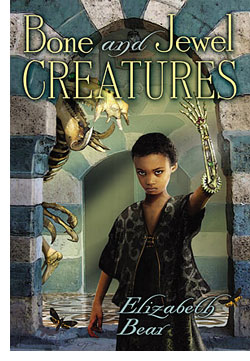
She's writing about a lot of her work, but it certainly applies to her forthcoming novella, 'Bone and Jewel Creatures' (Subterranean Press ; March 31, 2010 ; $20), a lovely, snappy story about a necromancer, an "Artificer," apprentices and the unforeseen consequences of kindness. Bear has been inhabiting these sorts of world for so long, she whip up a new one from whole cloth and get the details so right that the emotion comes through from beneath the clanking artifice.
Bear's little novella for Subterranean Press has a lot to recommend it. The cover art by Maurizio Manzieri is nearly as evocative as the text, and in itself a nice summation of the steampunk aesthetic. Since this is a Subterranean Press publication, you know you're getting a great book, and this is important. Books, of the paper and cardboard kind, are henceforth declared to be an endangered species. What's more they're very steampunk at this point in time, I mean – this is a technology that has remained unchanged for more than five hundred years. And that's just the printing pres version, books themselves, I don't know off the top of my head. That is a durable invention. Of course, here in the unimaginable-to-Gutenberg future, a guy like William Schafer can publish a book about an imagined world for just $20. That's pretty damned great price point, especially considering the book itself.
Bear is an amazingly impressive and prolific writer, who seems to write great work that wins awards — and deserves them — at an astonishing rate, over a huge variety of speculative fiction subgenres. 'Bone and Jewel Creatures' may be one of my favorites though. It's just chock full of a variety of sympathetic monsters, lovingly described and cunningly unfurled in a twisted, twisty plot that takes chances and makes some great imaginative leaps. It's somewhat deceptive really, to slot 'Bone and Jewel' creatures in as mere steampunk. Like Jack Vance, Bear writes with a purity that dissolves genres and lets the story speak.
The irony is that the book 'Bone and Jewel Creatures' is something like one of the critters in the title. Heedless of what is expected, Bear writes from her heart, and from the heart of the monsters she creates. Bear loves her monsters, and the readers shall as well.
New to the Agony Column
09-18-15: Commentary : William T. Vollman Amidst 'The Dying Grass' : An Epic Exploration of Simultaneity
Agony Column Podcast News Report : A 2015 Interview with William T. Vollman : "...a lot of long words that in our language are sentences..."
09-05-15: Commentary : Susan Casey Listens to 'Voices in the Ocean' : Science, Empathy and Self
Agony Column Podcast News Report : A 2015 Interview with Susan Casey : "...the reporting for this book was emotionally difficult at times..."
08-21-15: Agony Column Podcast News Report : Senator Claire McCaskill is 'Plenty Ladylike' : Internalizing Determination to Overcome Sexism [Incudes Time to Read EP 211: Claire McCaskill, Plenty Ladylike, plus A 2015 Interview with Senator Claire McCaskill]
Agony Column Podcast News Report : Emily Schultz Unleashes 'The Blondes' : A Cure by Color [Incudes Time to Read EP 210: Emily Schultz, The Blondes, plus A 2015 Interview with Emily Schultz]
07-05-15: Commentary : Dr. Michael Gazzaniga Tells Tales from Both Sides of the Brain : A Life in Neuroscience Reveals the Life of Science
Agony Column Podcast News Report : A 2015 Interview with Michael Gazzaniga : "We made the first observation and BAM there was the disconnection effect..."
04-21-15: Commentary : Kazuo Ishiguro Unearths 'The Buried Giant' : The Mist of Myth and Memory
Agony Column Podcast News Report : A 2015 Interview with Kazuo Ishiguro : ".... by the time I was writing this novel, the lines between what was fantasy and what was real had blurred for me..."
Agony Column Podcast News Report : A 2015 Interview with Marc Goodman : "...every physical object around us is being transformed, one way or another, into an information technology..."
Agony Column Podcast News Report UPDATE: Time to Read Episode 199: Marc Goodman : Future Crimes: Everything Is Connected, Everyone Is Vulnerable and What We Can Do About It