07-02-10:Sloane Crosley Asks 'How Did Get This Number'
Excellent Essays for the Short of Temper
The little things in life are, after all, not so little. That fateful July in summer camp, the first job that makes you crazy, the wedding with grizzly bear — all of them conspire to make you who you are.
Assuming of course, you've had the wedding with grizzly bear experience. Or the amateur Portuguese clowns. We all instinctively know that they are more important than they feel at the time. But it's just so hard to articulate why. Unless you're Sloane Crosley.
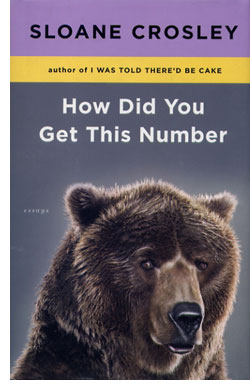
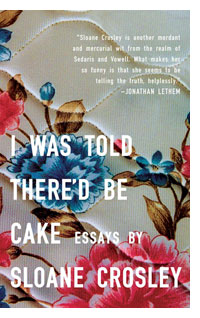
I confess. I have been sending email to and receiving email from Sloane Crosely for at least six years now. She's a publicist for Random House who has worked with a slew of great writers. They must have rubbed off on her, because her two books of essays, 'I Was Told There'd Be Cake' (Riverhead / Penguin ; April 1, 2008 ; $14) and 'How Did You Get This Number' (Riverhead / Penguin ; June 15, 2010 ; $25.95) are superb. Crosley tackles the little disappointments and irritations of life with that most potent of weapons, witty, well-written prose. Plus, she sort of spills the beans as to how women really think, which is both educational and entertaining, if you are a clueless gentleman. And if you know you're clueless, you're already a few steps ahead. If you think you know, then her writing is real eye-opener.
'I Was Told There'd Be Cake' collects fifteen shorter pieces that sort of circle around the drain of disappointment. Prepare to find about two or three lines per page so good you'll either want to read them out loud or weep, depending on your disposition. In "Bring-Your-Machete-to-Work Day," she writes about the joys of the Mac video game Oregon Trail, which she says, "seemed ripe for misuse." She would name her passengers after teachers and others she didn't like then let them expire; "MRS. ROSS HAS DIED OF DYSENTERY. This filled me with glee."
What filled me with glee was "You On A Stick," a revelatory (to this gentleman) look at the wonderful world of bridesmaids. This is the kind look at the raw, inner workings of a woman's mind that parallels what that traitor to his sex Nick Hornby did in 'High Fidelity.' "The second and far more troublesome kind of call — even worse than the laxative-inducing diatribes on water weight — was the 'quick, let's bond so it makes sense that you're in my wedding' call." Crosley has a knack for what can only be called making the unclear clear, for sorting out social entanglements with a precise, crisp wit that's engaging for all readers. Even those of us who enjoy a good monster novel now and again. (I have 'Meg: Hell's Aquarium' permanently ensconced in my reading queue.)
For all the consistently entertaining writing in 'I Was Told There'd Be Cake,' 'How Did You Get This Number' manages to up the ante. Here, Crosely offers, longer and more complex pieces — yes, again with the wedding (this time in Alaska, with Grizzly, thus the cover) — and striking out into the world, as she travels to Portugal during the off-season (thus the amateur circus clowns), and touring New York for us, so we do not have to experience the joys or the smells.
They key word in both books is that Crosley is simply such an outstanding prose writer that she can bring in readers who might think they'd find her subjects repellant. (In a certain sense, I suppose, these books do have something in common with 'Meg: Hell's Aquarium.') The easy thing to do as a reviewer would be to say she's like this person, or that person, or who-the-hell ever, but frankly, she's not like them. Crosley has her own style, which is really pretty tough. You get the feeling that she'd make a great gumshoe, popping a little pistol out of her purse and drilling down some surly scalawags with precisely-placed shots that would leave them squirming on the ground for the cops to round up. She does that with these essays; precise words, entertaining and intelligent thoughts, a lively sense of humor that's always smart. She knows the little things in life are not so little, and that words alone can make them manageable.
06-30-10:Mark Charan Newton Enters 'City of Ruin'
Inspector Jeryd Rides Again
We're letting the monsters out. What more can a reader ask for?
Modern fantasy is replete with intricate worlds and carefully developed civilizations. Modernish-seeming cities are becoming de rigeur. No longer are we subject to farmboys with a destiny, trudging from one boring battle to the next. All of this is good news, but forget about it. It's background compared to the fact that finally, at last .... we're letting the monsters out.
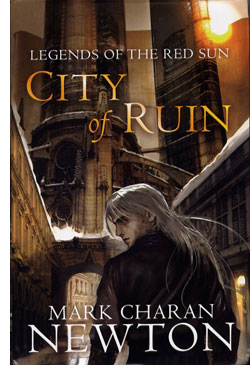
Mark Charan Newton's first novel in the "Legends of the Red Sun" series — 'Nights of Villjamur' — was an outstanding setup. It offered all the hospitalities of 21st century fantasy fiction, with a nice selection of monsters. But his new novel, 'City of Ruin' (Tor UK / Pan Macmillan ; June 4, 2010 ; £16.99) ups the ante in every respect. And it speaks to the growing influence in fantasy fiction — not of fantasy tropes, but rather of horror. Finally, our fantasy is getting the good drenching in blood and bizarreness that it deserves. It couldn't happen too soon.
With 'City of Ruin,' Newton and two of his protagonists from 'Nights of Villjamur' leave that capital city behind for less-gentle environs of Villiren, an outlier of the rotting empire and apparently much more prone to the unnatural. Commander Brynd Lathraea is manning the Night Guard and attempting to repel an invasion, while Inspector Jeryd looks for a serial killer. Of course this is just scraping the surface of a delightfully complicated plot. Newton knows how to keep the pages churning, how to bring together those complications in a manner that is richly satisfying — more so in this book than in Villjamur.
His first area of focus is the characters. Jeryd and Brynd are wonderfully complicated and easily engaging. Jeryd's sexuality causes him some rather relevant problems, while Brynd assumes the part of gruff, likable and ever-more complex beat-cop, so to speak. Of course he is much more, but Newton knows how to down play his characters' strengths in a manner that makes them even more appealing. On the other side of the equation, we meet Melum, a delightful half-vampire on the wrong side of the law but the right side of entertaining. Readers will definitely want to see more of him, and this is at least part of why Newton's fantasy is so much fun.
But I shall have to admit that for me, it's really pretty much mostly about the monsters, the ambience of horror in 'City of Ruin.' Newton really lets loose this time around, and careful readers will notice the nod to some of Clive Barker's best bits from 'The Books of Blood.' Newton knows that there's a thin line between the awesome and the horrific, an d he plays this well. His prose is very finely turned, which works to his advantage both in the aforementioned characterization and in his ability to create scenes that are more than pointless grue. Newton knows when and how to suggest the surreal and the monstrous in a manner that is both disturbing and entrancing.
The real news here is not just that Newton has a great new novel coming out. It's that 'City of Ruin' confirms not just Newton himself, but the potential power that is possible as fearless writers break down the barriers between genres. Blurring the boundaries of horror and fantasy opens up both to opportunities for redemption and terror. Newton knows that he has to earn his victories, and he's canny enough to serve up enough uncertainty to keep readers falling forward into the next abyss.
06-29-10: 'Twelve,' 'Thirteen,' Tongues of Serpents,' and 'The Strange Affair of Spring-Heeled Jack'
Historical SF & Horror Makes Rousing Summer Reading
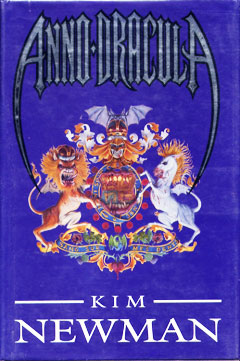
A day does not go by when something old is new again, and shiny, and lots of fun. Some of my most favorite reading experiences, books I can go back and visit again and again, came from the last gasps of the 1980's horror boom. Brian Stableford's David Lydyard trilogy ; 'The Werewolves of London,' 'The Angel of Pain,' 'The Carnival of Destruction' ; and Kim Newman's launch of 'Anno Dracula' were knockout novels that deftly combined supernatural horror and Victorian historical settings and figures.
Detailed, exciting, inventive and utterly gripping, they were both like nothing I'd read, but simultaneously evoked the books that brought me into reading in the first place; Bram Stoker's 'Dracula,' H. G. Wells 'War of the Worlds' and Jules Verne's 'A Journey to the Center of the Earth.'
While it would be nice if the current vogue of historically-set science fiction and fantasy brought back not just Jules Verne, Bram Stoker and H. G. Wells but Stableford and Kim Newman as well, at least the current practitioners have proved themselves adept and imaginative to keep readers engaged.
Apparently, a zeppelin per week is not enough for the historical-speculative fiction masses. So get read to be overrun, over-flown and sprung-upon as authors new and not-so-new make the case for traveling back in time to experience the present as a wild-eyed future. Or even a past that will seem more futuristic than the bad science fiction novel that we currently call reality.
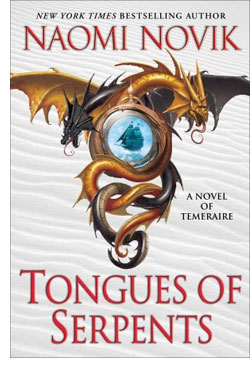
The Napoleonic era is our first stop. I trust that readers have kept up with Naomi Novik, who inserted intelligent dragons into the Napoleonic era with her first novel 'His Majesty's Dragon.' When it comes to serial fiction, the trend is to take longer between novels and make each novel increasingly (and often unfortunately) long. Novik bucks this trend with her Termeraire series. She's now on book six, 'Tongues of Serpents' (Del Rey / Ballantine / Random House ; July 13, 2010 ; $25), and she's offering readers tight, well-written military thrillers set in a fantastically re-imagined world. This time around, for reasons best left for readers to discover, Temeraire and Laurence are sent to Australia, where they'll meet up with all manner of ill-mannered foes. Take your time and relish this one. It's short enough to be a preface for the usual sixth-novel doorstop in a series.
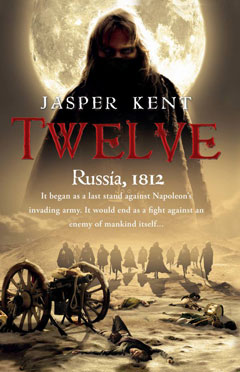
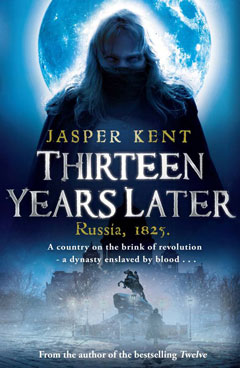
You don't have to leave the Napoleonic era yet, either. Over at Pyr, I trust that listeners recall editor Lou Anders talking about a novel by Jasper Kent titled 'Twelve' (Pyr / Prometheus Books ; September 2010 ; $17). Kent directs your attention to the eastern front, where Captain Aleksei Ivanovich Danilov enlists twelve mercenaries from Christian Europe to help turn back the French. They call themselves the Oprichniki, fight only at night and leave no bodies in their wake. Danilov soon begins to wonder whether he's made the right decision. Readers who start this delightfully dense work will know that they have indeed made the right decision. Kent matches supernatural with psychological horror and pits them both against the horrors of war, 1812-style. The pace is stately and the effect is immersive. And since one is not enough, readers can be assured that this is the first of a quintet, and that the sequel, 'Thirteen' is ready to go.
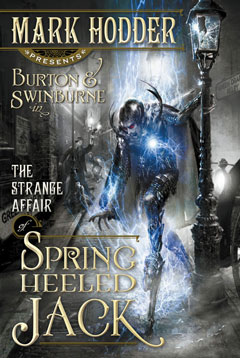
Kim Newman certainly pioneered the inclusion of characters based on both fictional and historical sources in his writing. Mark Hodder carries on the tradition in 'Burton and Swinburne in The Strange Affair of Spring-Heeled Jack' (Pyr / Prometheus ; September 2010 ; $16), in which Sir Richard Francis Burton, the famous explorer, is joined by the equally infamous poet Algernon Charles Swinburne. As an English major who spent a fair amount of time reading, analyzing and writing about Swinburne, I fond this to be a delightful pulpy romp, where around each corner lurks an improbable monster or historical figure, re-jiggered to slot into Hodder's science-fiction horror novel. Like something out of Tom Baker-era Doctor Who, 'Burton and etc..' is utterly non-stop. Hodder has his way with both history and historical figures, but manages to be entertainingly informative and thrillingly over-the-top. Where Jasper Kent goes for nuanced atmosphere, Hodder turns the whole shebang up to eleven and sets forth the dogs of war, hell, science fiction and horror. No word yet on a sequel, but one seems delightfully inevitable.
Sure, you should start with the originals; Jules Verne, Bram Stoker, H. G. Wells. Best to drink the undiluted essence first; step next to Stableford and Newman, if you've not already done so. Then as the days grow shorter, join the shadows and immerse yourself in history that never was. Look up from your reading and your own science fictional life might not seem so bad; our current dystopia could, however stand a better fleet of zeppelins.
06-28-10:'A Visit from the Goon Squad'
Revisiting the Novel Genre
In the post-pulp era, the novel's psyche was splintered into a variety of genres. All the sorts of fiction that used to be simply "novels" were now relegated to types of novels. The origins of the novel as a genre itself were lost in a blizzard of increasing derivations, photocopies of photocopies. Now, anything that steps beyond first-person singular or third-person omniscient narration is tagged as experimental, ignoring the rich heritage of experimentation that produced what we now call "novels" in the first place.
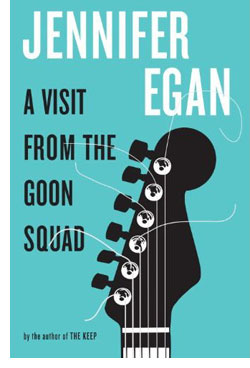
But on a reading level, it's all about the novelistic reading experience. And by that measure, Jennifer Egan's 'A Visit from the Goon Squad' is superb novelistic reading experience. Egan manages to use pretty much everything in the writer's toolkit — genre, perspective, even advanced (and generally abused) literary technology, in this case, PowerPoint — to create an engaging, involving story about single group of people we come to care deeply, and who manage to offer us a fresh perspective on our own lives. This is what the novel was always mean to accomplish. Egan's command of the rules is so firm she can break them with utter impunity.
'A Visit from the Goon Squad' is first and foremost, fun and startlingly engaging to read. We start in very familiar territory. Sasha is talking to her therapist about her problem with stealing. Like a crow, she's accumulated a stash of artifacts that bring back memories of different periods of her life. Each object represents something utterly different from those around it. When her session ends, we find ourselves with Bennie, her one-time employer. He was once the punk rock promoter who guided some decent bands to popularity. The ties between the two segments are intricate and personal, but also abstract and tantalizing. As the next chapter unfolds, we somewhere else, with someone else. But by then, the connections have been made.
Egan's novel is a brilliantly entertaining riff on memory, time, art and how humans connect at every level; family, friends, predators and (sometimes willing) prey, through art, commerce, music, technology, sex, love and friendship. She sort of follows the lives of Sasha and Bennie, but follows them via a funhouse mirror that leads her to the past, the present and even the future. Every subsequent chapter employs a new literary perspective, a new character perspective and a new literary technique. It's as if the novel itself has become a four-dimensional tesseract, and Egan has unfolded the cubes.
In the hands of a lesser talent, such a device could seem both heavy-handed and confusingly annoying. But Egan turns it into a delightful literary mystery — a mystery in which the very story being told has been torn loose from the standard issue timeline and re-folded into a gorgeous, moving and often very funny origami. Readers willing to divorce themselves from kitchen-window epiphanies and thrill-a-minute explosions that plod from A to B will find plenty of thrills and more startling epiphanies in Egan's entertaining re-discovery of the novel form. In its earliest incarnations, the novel knew no limits. Writers were simply trying to tell story using every literary tool they could lay their hands on. Egan follows suit with greatly entertaining and striking success.
Egan certainly has a natural talent for speculative fiction. Portions of 'A Visit from the Goon Squad' are evocative stories set in the near future; one notable chapter is written in PowerPoint. Each segment is strong enough to stand on its own — and Egan has even published the PowerPoint story online. But don't make the mistake of thinking of 'A Visit from the Goon Squad' as a series of short stories. The great success here is in the entirety of the reading experience, from beginning to end. This is a novel not unlike others you have read, and yet it is entirely unlike any other than has ever been written.
At the core of the technical brilliance on display here — generously used to make the reading experience both more entertaining and poignant — is a writer telling readers a story about people, and as well about themselves. Egan's funhouse mirror is easily turned on the reader's lives. For all the playing with time here, all the literary pyrotechnics that rival any orchestrated display of fireworks, Egan is, in the final analysis, pursuing reality as we experience it in our own lives. No matter how many novels we read that start at the beginning and end at the end, we are unable to organize our own lives in this manner. Our memories do not start with our first scream in the world and end with our last breath. 'A Visit from the Goon Squad' is easy and enjoyable to read not just because it is a bold departure from most novels, but because it is a perfect reflection of how we experience the broken shards that mirror our own lives.
New to the Agony Column
09-18-15: Commentary : William T. Vollman Amidst 'The Dying Grass' : An Epic Exploration of Simultaneity
Agony Column Podcast News Report : A 2015 Interview with William T. Vollman : "...a lot of long words that in our language are sentences..."
09-05-15: Commentary : Susan Casey Listens to 'Voices in the Ocean' : Science, Empathy and Self
Agony Column Podcast News Report : A 2015 Interview with Susan Casey : "...the reporting for this book was emotionally difficult at times..."
08-21-15: Agony Column Podcast News Report : Senator Claire McCaskill is 'Plenty Ladylike' : Internalizing Determination to Overcome Sexism [Incudes Time to Read EP 211: Claire McCaskill, Plenty Ladylike, plus A 2015 Interview with Senator Claire McCaskill]
Agony Column Podcast News Report : Emily Schultz Unleashes 'The Blondes' : A Cure by Color [Incudes Time to Read EP 210: Emily Schultz, The Blondes, plus A 2015 Interview with Emily Schultz]
07-05-15: Commentary : Dr. Michael Gazzaniga Tells Tales from Both Sides of the Brain : A Life in Neuroscience Reveals the Life of Science
Agony Column Podcast News Report : A 2015 Interview with Michael Gazzaniga : "We made the first observation and BAM there was the disconnection effect..."
04-21-15: Commentary : Kazuo Ishiguro Unearths 'The Buried Giant' : The Mist of Myth and Memory
Agony Column Podcast News Report : A 2015 Interview with Kazuo Ishiguro : ".... by the time I was writing this novel, the lines between what was fantasy and what was real had blurred for me..."
Agony Column Podcast News Report : A 2015 Interview with Marc Goodman : "...every physical object around us is being transformed, one way or another, into an information technology..."
Agony Column Podcast News Report UPDATE: Time to Read Episode 199: Marc Goodman : Future Crimes: Everything Is Connected, Everyone Is Vulnerable and What We Can Do About It