"Few liberals or progressives," writes Eric Alterman, "would take issue with the argument that, significant accomplishments notwithstanding, the Obama presidency has been a big disappointment." Mid-summer; July, 2010, and for reasons that seem both hidden and readily apparent, the election of Barack Obama as president of the United States has not yielded the hoped-for result: more hope.
In fact, things look just as bad, if not worse. Even with a clearly intelligent and competent President, who obviously has the best intentions and yes, is willing to compromise a powerfully positive vision to get something done, even so — the feeling of screaming, ugly desperation remains. The situation seems hopeless. Democracy is damned-well dead, a shadow of its former self. It is no longer democracy; it is at best, what Alterman calls, in the title of his mid-summer essay for The Nation, "Kaubuki Democracy," shadow-play theatrics full of sound and fury, signifying nothing.
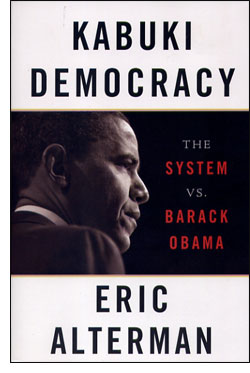
In the wake of mid-term election the President himself called "a shellacking," Alterman has taken his original article and expanded it into 'Kabuki Democracy: The System Versus Barack Obama' (Nation Books / Perseus Book Group ; January 11, 2011 ; $14.99). While the original article does a fine job exploring Alterman's premise, the book-length version is far more satisfying, giving him the chance to expand and explore his reporting, his interpretations of the facts and his conclusions. You're going to find this book in whatever part of the bookstore generally contains the "librul meedjya" books, but if it's not there, look over in the horror section. And remember that to a degree, even The Texas Chainsaw Massacre had a happy ending.
Here is the US of A, we all lived through the same two years. But depending on how you choose your news, you might think that a percentage of the population was shunted over into Bizarro World; or at least they were getting their cable subscription and newspaper delivered from there. Soon after Alterman published his original essay, you could read all about it; or more precisely, you could read all about, or hear all about, how he had supposedly misused the word "Kabuki" and misunderstood the concept of Kabuki theater. This was not just the province of those who disagreed with his arguments. This response was universal. In a sense, this was the perfect "Kabuki" response to the article; it ignored the seriously analytical content and distracted us with a vapid discussion that rested in a deliberate misinterpretation of what Alterman was insinuating. The power of Alterman's title, the power of his book, is that we all know precisely what the term "Kabuki democracy" is meant to imply. No matter what your beliefs, 'Kabuki Democracy' is a book worth your valuable reading time.
The value of writers like Alterman is two-fold; selectivity and analysis. The former is the key to the latter. A lot has come to pass in the opening years of the Barack Obama, and Alterman's selection of what is important, what is worth talking about, is the key to this book's power. Alterman's story here — the plot — is critical to the theme. By focusing on the mechanisms of government and the problem of working with a group elected to govern who are in principle opposed to governing, Alterman cuts through a lot of fluff. He talks about the unabated effects of lobbying. After a raft of criminals from both parties ended up in the klink, it's easy to think that, "Problem solved." That's clearly not the case, and no party is exempt from the ill effects of more and more money flowing into the system.
Having found the facts that matter, Alterman subjects them to a careful and clear-headed analysis. Yes, he is a Progressive Liberal, with an interest in establishing a government that speaks to those beliefs. That said, he makes a great case as to why those beliefs have a particularly hard time getting written into law. The Texas Chainsaw Massacre made a great case as to why teenagers shouldn't root about apparently vacant houses out in the middle of Nowhere, Texas. Your joy will trace a similar path. Yes, one bloodied woman may emerge, and yes, there is something we can do to Make Things Better and bring about Hope. The problem being that we have to get up off our keester and do it. Of course, the alternative is to end up hanging from a meat hook in the middle of July.
01-17-11:Diana Secker Tesdell Selects 'New York Stories'
Everyman's Pocket Classics
Have I seen these books before? I must have, but I don't recall the specifics. To be honest, they're not books that lend themselves to specifics, and this is to a degree deliberate. They are, after all, called "Everyman's Classics."
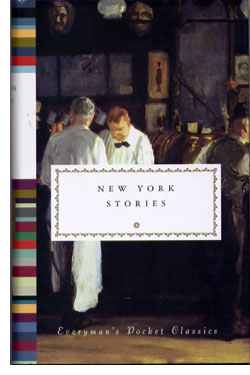
I have to admit that I found the cover design intriguing. The book is classy and compact. It's one of those hardcovers that actually has a classic feel to it. I suppose it's the size, and the anonymity as well. No editor credited on the cover. No blurbs. The editor's name appears once, on the title page. Open the book, turn to the table of contents, and you'll see a spectrum of authors, every one a star. If you need a book of short stories about New York, you're going to be hard pressed to find a better selection.
The content of this book is nothing less than spectacular. You're not going to find a bad story in the bunch, though you might find some that are not to your taste; at least initially. From Jack Kerouac to Junot Díaz, you'll a nice packet history of American literature here, and probably some writers you've wanted to read. For example, Amy Hempel, whose "Reference #388475848-5" is a delightful screed addressed to the Department of Parking Violations. For you, it might be Shirley Jackson's "Pillar of Salt" or Katherine Anne Porter's "Theft." The selection certainly lives up to the "Classics" designation.
But I have to admit, that I was intrigued by this anonymous series, so I dug a little deeper to find out the history — and happily, there is a history. It seems that back in 1906, one Joseph Dent, a bookbinder and publisher (no relation to Arthur, that we know), decided to do the world a favor. He decided to publish the Everyman's Library, a series of one thousand classics that would be available at one shilling apiece. "For a few shillings the reader may have a whole bookshelf of the immortals; for five pounds (which will procure him with a hundred volumes) a man may be intellectually rich for life."
It was a daring idea at the time and the scope was unprecedented. Dent started with Jane Austen (sans zombies, vampires, ghouls, monsters, sea-serpents and werewolves), then followed on with Dickens. Pretty much all the stuff that you wither had to or wanted to read when you were in high school was in his oeuvre. Here's a case where one man's taste influenced the world.
The series was re-launched in 1991, with the idea of making nice boks, and they've succeeded. They're printed on acid-free paper, include silk-ribbon bookmarks, and sewn cloth bindings. If you like books and I like books, then here are the best that money can buy. There's more range than you'd expect; they've just released Isaac Asimov's Foundation series, with an introduction by Michael Dirda and a striking image of the author on the cover.
Of course, this is not just about art. It's about business too, so there's a web page for the series here. That said, this is the one place where business and art seem to work to one another's advantage. That is rarely the case in today's best-seller-centric world. We hear a lot of talk about the death of books, especially hardcovers. There's a degree of reason to worry — and here, in Everyman's Library is a reason to be cheerful — one, two, three.
New to the Agony Column
09-05-15: Commentary : Susan Casey Listens to 'Voices in the Ocean' : Science, Empathy and Self
Agony Column Podcast News Report : A 2015 Interview with Susan Casey : "...the reporting for this book was emotionally difficult at times..."
08-21-15: Agony Column Podcast News Report : Senator Claire McCaskill is 'Plenty Ladylike' : Internalizing Determination to Overcome Sexism [Incudes Time to Read EP 211: Claire McCaskill, Plenty Ladylike, plus A 2015 Interview with Senator Claire McCaskill]
Agony Column Podcast News Report : Emily Schultz Unleashes 'The Blondes' : A Cure by Color [Incudes Time to Read EP 210: Emily Schultz, The Blondes, plus A 2015 Interview with Emily Schultz]
07-05-15: Commentary : Dr. Michael Gazzaniga Tells Tales from Both Sides of the Brain : A Life in Neuroscience Reveals the Life of Science
Agony Column Podcast News Report : A 2015 Interview with Michael Gazzaniga : "We made the first observation and BAM there was the disconnection effect..."
04-21-15: Commentary : Kazuo Ishiguro Unearths 'The Buried Giant' : The Mist of Myth and Memory
Agony Column Podcast News Report : A 2015 Interview with Kazuo Ishiguro : ".... by the time I was writing this novel, the lines between what was fantasy and what was real had blurred for me..."
Agony Column Podcast News Report : A 2015 Interview with Marc Goodman : "...every physical object around us is being transformed, one way or another, into an information technology..."
Agony Column Podcast News Report UPDATE: Time to Read Episode 199: Marc Goodman : Future Crimes: Everything Is Connected, Everyone Is Vulnerable and What We Can Do About It